Producing audio narration used to require a recording studio, a voice actor and weeks of work. The artificial intelligence in Cabinet of Wonders narrates your texts in a few minutes. Sometimes, though, you have an authentic recording that no synthetic voice can replace. The curator who spent months preparing the exhibition. The artist who created the work. The witness who was there in person.
When your own recording makes sense
Not every stop needs an original voice. But there are moments when an authentic recording enhances the visitor experience. The overall impression of the narration can be strengthened by, for example:
- The curator or author of the exhibition. The person who conceived the exhibition is often the best one to present it. Visitors hear the intent first-hand.
- A living artist. The author's voice gives the work a personal dimension, whether it hangs in a gallery or stands in a public space.
- An actor or a well-known personality. A familiar voice gives visitors one more reason to come.
- A witness of the events. At memorials and exhibitions of modern history, a personal memory creates a powerful experience that a synthetic voice cannot convey.
- A person connected to the place. In mining museums, former miners lead the way; in a historic palace, a member of the original noble family. Someone who knows the place from their own experience tells its story more credibly than anyone else.
How it works
For every stop, route and place introduction, you can choose whether the audio is generated by artificial intelligence or whether you upload an original recording. The choice applies to each stop separately, so you can combine both approaches. For example, the curator narrates three key stops and AI voices the rest of the route.
Using your own recording doesn't mean giving up other languages. Cabinet of Wonders takes care of them on its own:
- The spoken word in the recording is automatically transcribed into text.
- You can review the transcript and edit it if needed.
- The text is translated into the other languages.
- For each language, audio is generated in a voice of your choice.
Visitors listening in the original language hear the original voice. International visitors get the same content in an AI version in their own language.
Tip: For the other languages, choose a voice that resembles the original in age and timbre. A similar tone makes the result more convincing.
How to upload your own recording
- Log in to Cabinet Studio.
- Open a stop, a route or the place introduction.
- In the Audio card, switch to Upload speech recording.
- Upload the recording file.
- Review the transcript and edit it if needed.
- Choose the voice that will narrate the other languages.
- Save and generate audio for the other languages.
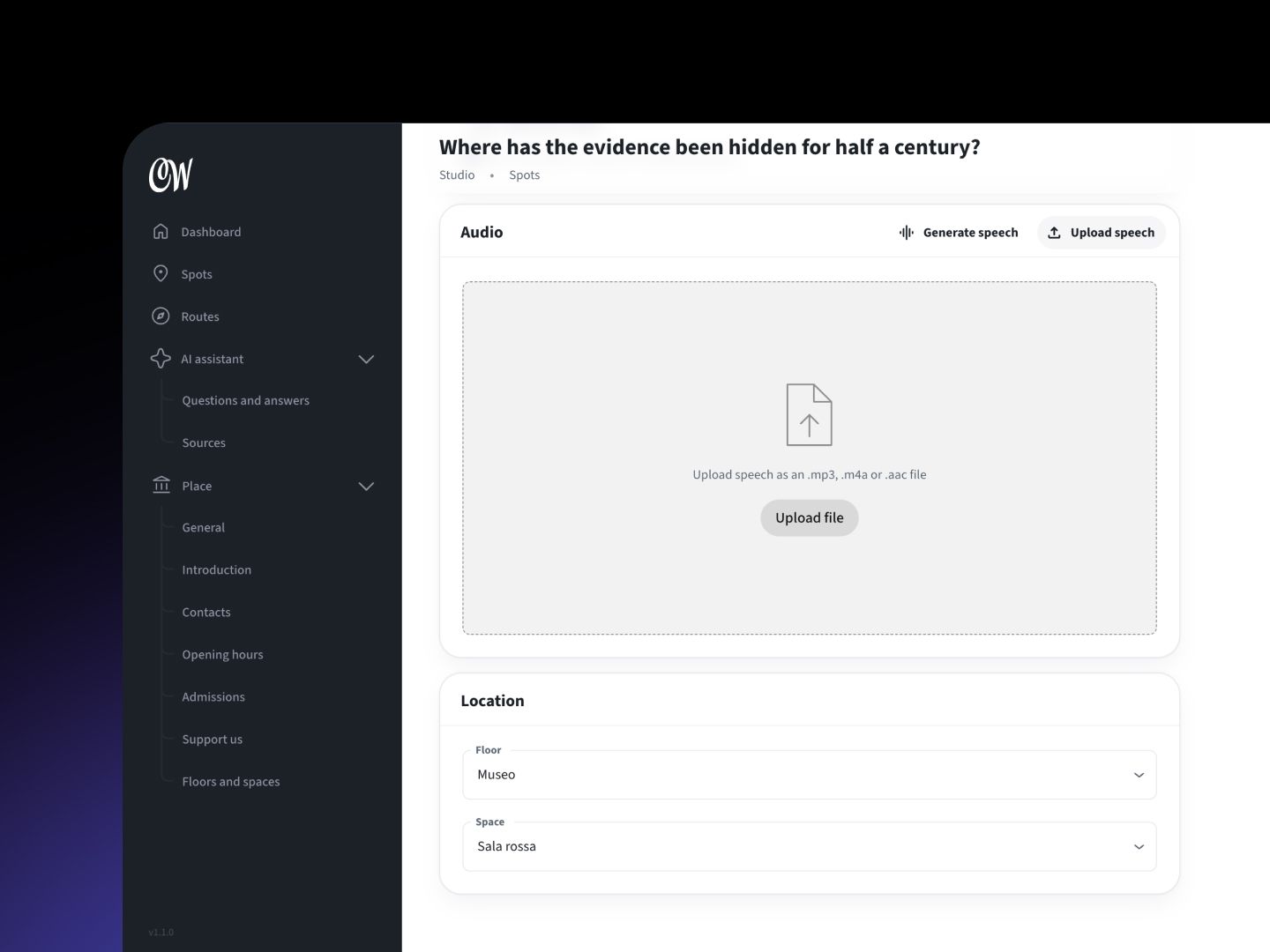
In the Audio card, switch to Upload speech recording.
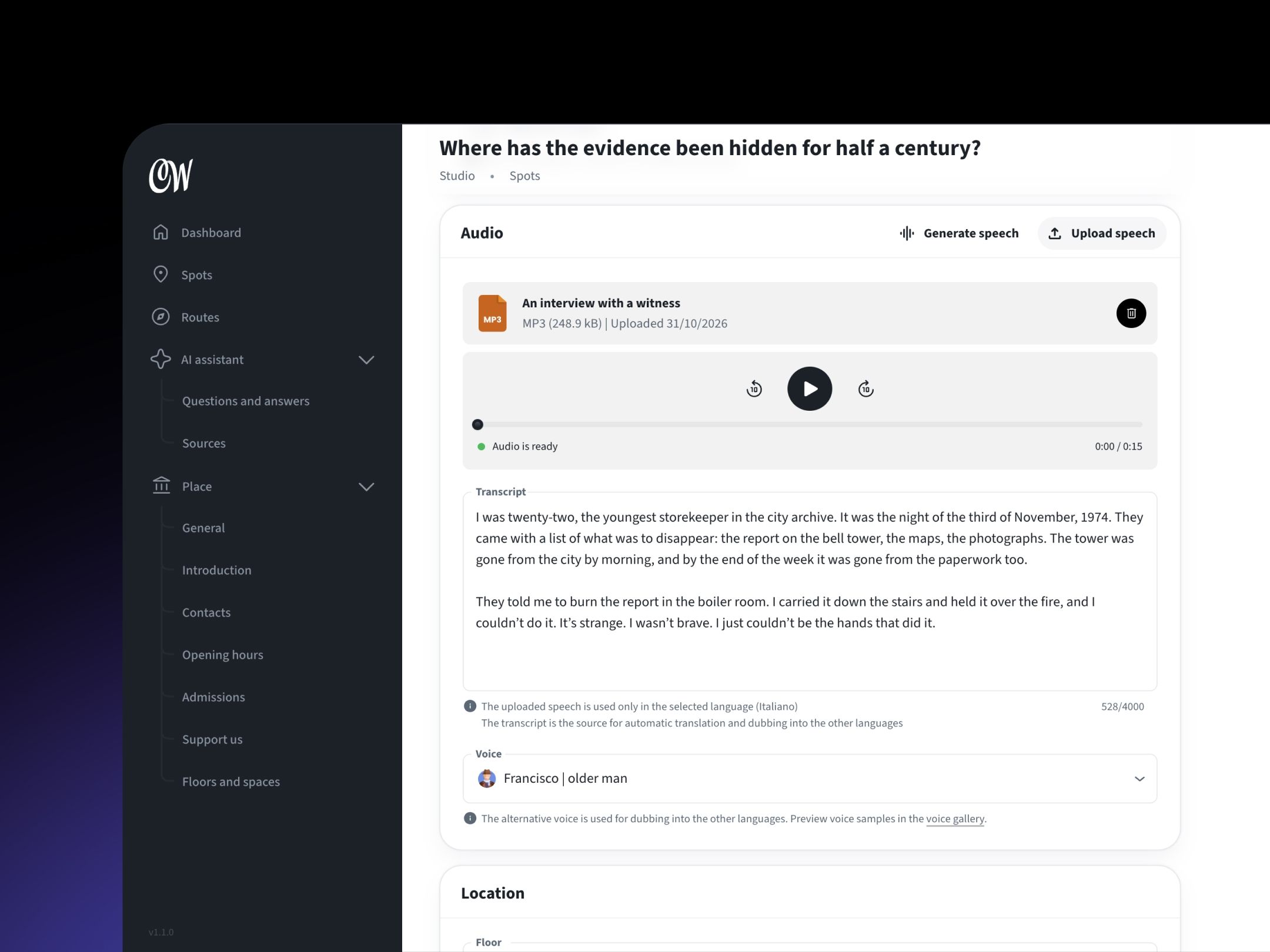
The spoken word in the recording is automatically transcribed into text. Translations into the other languages are then generated from this transcript.
Good to know
- Formats: you can upload MP3, M4A and AAC audio files.
- Spoken word only: the feature is not yet intended for music or songs.
- Recording quality: record in a quiet environment, with a good microphone and no background music. A clean recording improves not only the listening experience but also the accuracy of the transcript.
- Transcript review: it pays to check names, dates and technical terms. Translations are created from the transcript, so an error in it can carry over into other languages.
Authenticity without language barriers
A museum is an institution that society trusts. Visitors expect not only information from it, but also the assurance that they know where it comes from. The original voice of a curator, artist or witness carries that assurance. It is first-hand testimony, and when it is available, it is well worth publishing.
In translation, part of the authenticity is inevitably lost. International visitors won't hear the colour of the voice, the dialect or a play on words, but they will still grasp the idea, the facts and the story. Thanks to automatic translation and a generated voice, they can listen to a narration they would otherwise have no chance of understanding.